Really achieving your travel bucket list


Assuming we live for 85 years, we have about 60 years (discounting 15 years at the start and 10 years at the end) during which we have to travel to all the places we want to see before we die. Assuming again that we can take time off work/school an average of 3 times a year, that leaves us with 180 opportunities to travel. That’s not much – just less than 20% of the famous “list of 1000 places to see before you die”. Which means that if you have a travel bucket list and you’re serious about achieving it, you better get off your ass and get going! But society (and self doubt) has a way of nagging at your ear to put that travel bucket list on hold, most of the time indefinitely. Myths about the dangers, cost and selfishness of travel are perpetuated to deter those with less resolve. Here are some of the biggest myths which I will attempt to debunk:

1) No time 

Most working adults have some off day entitlements ranging from 2 to 6 weeks. And yet I’ve heard ‘no time’ for a sorry excuse to not travel many many times. The real problem is not ‘no time’ but not knowing how to use that time to travel when the opportunity presents itself e.g. when you’re suddenly forced to clear leave at the end of the year or when you’re in between projects. During these times, the excuse evolves from ‘no time’ to ‘I don’t know where to go’. Well, here’s how to get around that problem. They say luck is opportunity meets preparation and there is no truer statement in this context. Plan ahead: I keep an excel workbook which contains my travel bucket list with notes on the best month(s) to travel to each place, a 5 year travel plan and brief itineraries for each place. That way, when I suddenly have say 2 weeks in May freed up, I know exactly where to travel. Never let your lack of preparation hold you back on your travel goals.

2) No companion 

Here’s a revelation that my friends will find surprising about me: I like having travel companions and travel solo only when I can’t find anyone to come along with me. Humans are social creatures – we all crave and need companionship, some more than others. But we also have different schedules and life priorities and therefore cannot always be there for one another. Your friends/family members might not be available at the precise period you have to travel or even be interested in where you want to go. Don’t let the priorities of others dictate your’s. If you’ve never traveled solo, now is the time to try. You’ll feel scared, worried, liberated and empowered at the same time – these feelings are all very normal. If you’ve tried it and swear that it’s not for you, reconsider if you spent most of your time when traveling solo wishing your loved ones were there with you. If you did, that was a futile exercise and I implore you to try again. Extroverts may find it harder to travel solo but introverts can all identify with the inner peace and introspection that comes with solitude. Plus you’ll get to meet other solo travelers just like you!

3) No money 

Ah the no money excuse. Yes we can all do with a lot more money but until we find a way to have infinite amounts of money, we need to learn how to allocate the limited resources we have effectively. There are ways to travel cost effectively (see my previous post) and there are ways to save up (consider not buying so many handbags, clothes, tech gadgets etc. and not eating out at expensive restaurants). Some people have the idea of putting off all their travels until retirement when they expect to be sitting on a pile of cash. There are several problems with  this theory. Firstly, how do you know you will live to see retirement? Secondly, if you retire at 65, that leaves you with only 10 – 15 years to travel and there are many things you wouldn’t be able to do or do as comfortably at that age as compared to your younger days. Thirdly, ever heard of inflation? A trip that costs $2000 today will cost 2 to 3 times more later in your lifetime. Simple math.

And remember : It’s always possible to make more money but youth, once lost, is lost forever.

A hiker’s guide to rain gear: Part 1 – rain jacket

Prologue: Iceland, September 2015: 

It was raining rather hard outside and we were about to leave the cozy confines of the carpark building to walk 45 minutes to the Thrihnukagigur volcano. The walls of the building were lined with bright yellow, oversized raincoats and we were told by our guide to pick one and put it on. Walking in that raincoat would not be pleasant. It would be cumbersome and we would be all sweaty inside.

“We don’t need to wear this; we all have rain gear!”, we protested.

Our guide looked at us and deadpanned “this is Iceland. Nothing but rubber is waterproof.”

Rain jacket basics 

It is true that nothing but rubber is truly waterproof and that’s an important point to keep in mind when deciding on what rain jacket to buy. Almost every brand of rain jacket in the market touts itself as waterproof. Be skeptical, be very skeptical. Remember, nothing but rubber is waterproof. So are you supposed to wear a rubber rain coat for hiking in the rain? No. Because so much of your own sweat will be trapped beneath the rain coat that you might as well have been drenched by the rain (and risk hypothermia).

The aim, when choosing a rain jacket, is to select one that is water-resistant, breathable, lightweight + packable and as I’ve come to learn, durable.

Water-resistance is measured in terms of the water pressure beyond which the jacket will leak. A sufficiently water-resistant rain jacket should have a waterproof rating of at least 10,000mm. If water-resistance determines how much water (rain) is likely to get in, breathability determines now much water (sweat) is likely to get out. Breathability is measured in the amount of water that passes through one square metre over a 24 hour period. This page here discusses waterproof ratings and breathability in greater detail.

A durable rain jacket is one that will retain its water-resistance even after many washes. For years I relied on my Marmot Precip rain jacket to keep me dry but over time the fabric lost its water resistance and left me drenched after hiking in it in a downpour. Thanks buddy. A lightweight jacket goes a long way in reducing the weight on your body as you walk. You’ll also appreciate a jacket that packs really small and takes up little space in your bag. Trust me.

Good to haves: Most people forget about the zips on the jacket but water will leak through zips unless it’s sealed with a waterproof coating. Otherwise you’ll end up dry except with a strip of water down the front. Storm flaps also help to prevent water from leaking through the zips. A hood that extends beyond your face is good for keeping some of the wind-driven rain off your eyes. Pit zips are a very useful feature for venting those sweaty arm pits. Zippered pockets are highly recommended for stashing away your freezing hands and phone/small camera.

Comparison of the Marmot Minimalist and Mountain Hardwear Plasmic Jackets 

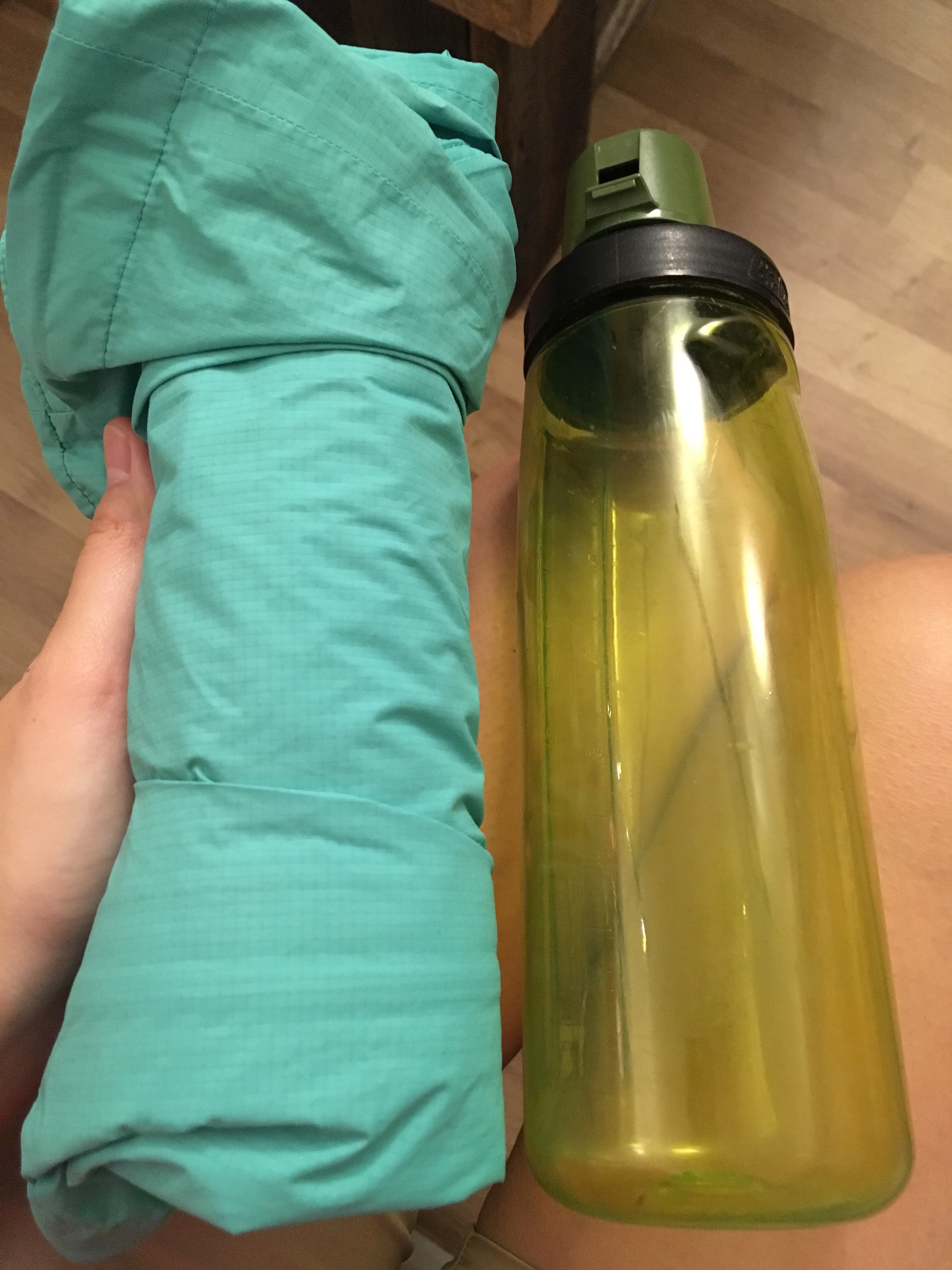
I’ve owned (and used) the Mountain Hardwear Plasmic jacket for 2 years now. I got it as a replacement when my old Marmot Precip failed. It’s the one on the right in the picture above. I like it because I’ve not encountered a leak so far even after sustained periods of rain and numerous wash cycles (points for water-resistance and durability!). It is also very lightweight and packable and rolls up into a small bundle the size of a bottle.

What I don’t like is that the zips are not storm-sealed, which means water can leak through the zips although I’ve only encountered that problem when I sprayed the zips with a showerhead. But be prepared for some leakage and a potential wet strip down the front if hiking in this jacket under strong windy and rainy conditions. I also feel sticky with sweat almost half the time I’m wearing it so I don’t think the fabric is all that breathable even though it’s supposed to have good breathability according to the manufacturer specs (15,000).

One thing I really miss about my old Marmot Precip is the storm flap over the zips. I just felt a lot more assured knowing that rain wasn’t going to leak through that way. But I didn’t want to buy another Precip knowing that the material is not durable (makes me feel like a sucker if I did buy!). And so I bought the Marmot Minimalist (left in picture above) which is constructed just like the Precip except with pit zips (hooray!) and with the Gore-Tex Paclite fabric which boasts a whopping waterproof rating of 28,000mm (vs. 20,000mm for the Plasmic) and a breathability of 15,000 (same as the Plasmic). It’s my first Gore-Tex jacket so I’m super excited. It’s heavier and packs bigger than the Plasmic but not much more. I can’t say anything about its breathability yet because I haven’t tested it on the trail but I sure hope that it’ll be better than the Plasmic even though they have the same breathability numbers (will update this post when I return from testing it on the West Highland Way next month!).